Saturday, December 20, 2008

Debunking the myths

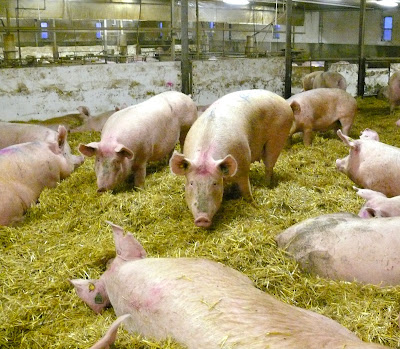
This photograph was taken in 2006 on an intensive livestock farm in Canada.
Notice the windows, the bedding, and the snoozing, contented sows.


From peta factsheet
"Factory Farming: Mechanized Madness"


The green pastures and idyllic barnyard scenes of years past, which are still portrayed in children’s books, have been replaced by windowless metal sheds, wire cages, gestation crates, and other confinement systems—what is now known as “factory farming.”

Well peta you hit the nail on the head there "portrayed in children’s books" is exactly where the "green pastures and idyllic barnyard scenes" exist because they never did exist in real life.

Prior to the advancements in technology and the need, driven by an ever increasing population, farming was a very risky business for humans and animals alike. Animals lived in cold draughty buildings or outdoors where they were subject to cold or heat, wind and rain, to predators, and every disease known that blew in with the wind or on visiting animals, humans or vehicles.


Farmed animals have no federal legal protection from horrific abuses that would be illegal if they were inflicted on dogs or cats: neglect, mutilations and drug regimens that cause chronic pain and crippling, transport through all weather extremes, and inhumane slaughter. Yet farmed animals are no less sensitive, intelligent, or capable of feeling pain than are the dogs or cats whom we cherish as companions.

Horrific abuses? Mutilations? Drug regimens? Chronic pain and crippling?

And these things benefit the producer in what way exactly?


Deprivation and Disease
The factory-farming system of modern agriculture strives to produce the most meat, milk, and eggs as quickly and cheaply as possible—and in the smallest amount of space possible.

And guess what? By using the smallest amount of space we achieve the following benefits to society:

Affordable meat products
Affordable poultry products
Better standards of health and care for the animals (compared to pre 1960 farming methods)
Better working conditions for the stockman (compared to pre 1960 farming methods)
More land available for wildlife/human recreation than there would be with less intensive farming methods.
The virtual certainty that global famine will never happen.


Cows, calves, pigs, chickens, turkeys, ducks, geese, rabbits, and other animals are kept in small cages or stalls, where they are often unable to turn around.

Pigs in some countries are sometimes kept in gestation crates. Layer chickens are sometimes kept in battery cages. Veal calves are kept individually, usually in small huts with an outside area. Rabbits are usually kept in cages.

As for the other animals? Tut,tut,tut, peta. Methinks you exagerate to gain effect.


They are deprived of exercise so that all their energy goes toward producing flesh, eggs, or milk for human consumption. They are fed drugs that fatten them faster, and they are genetically manipulated to grow faster or produce much more milk or eggs than they would naturally.

Oh dear peta, you do come up with some rubbish. Where do you get it from? inbred's warped brain?

Intensively farmed livestock are not fed drugs to fatten them faster. They are fed good, wholesome food that is very expensive. Diets are carefully formulated to meet the needs of the animal. Feeds contain primarily wheat and barley, supplemented with whatever else may be available, such as pulses.


genetically manipulated to grow faster or produce much more milk or eggs than they would naturally?

God give me strength! No. Animals produce the amount of milk, meat or eggs that they produce because the poor producing animals are culled out. There's nothing new about this, its been going on for thousands of years. Farmers have always selected their best animals to produce the next generation.

Monday, December 15, 2008

Factory farming 101


Does abuse really exist on livestock farms to the extent the ARA's claim?

No.

It would be wrong to say that abuse does not exist, because it does, but, by no stretch of the imagination could it be considered the norm.

In my opinion, abuse tends to occur when:


1) Its the wrong person doing the job.

Ignorance, incompetence, lack of empathy, laziness, can all be a recipe for abusive situations.

Filling job vacancies on livestock farms can be very difficult. Sometimes, in desperation, companies will employ anyone with two arms and two legs regardless of their aptitude for the job. This can be disastrous for the animals. Luckily such people rarely last more than a few weeks.


People who choose to work with animals need to have certain qualities, first and foremost, they should like animals and enjoy being around them. Working with animals requires patience, dedication, empathy and compassion, but it doesn't mean being soppy and letting the animals walk all over you, animals need to know who's boss, and I believe that applies regardless of species.

Sometimes a person thinks, "I like pigs (elephants, horses, dogs, whatever) I want to work with them," but then, when they are faced with the reality of feeding, cleaning out, bedding, dealing with an uncooperative creature, etc. they discover they don't have the necessary skills or the right temperament for the job. So animals are left unfed, without water, dirty, cold, untrained, illness is not recognized or not treated.

This is abuse through neglect and rarely happens in intensive livestock farms because there is almost always someone else who does care, to take up the slack.


2) When a person who, under normal circumstances, would not treat an animal badly is under stress because of exhaustion, sickness, worry/anxiety, time constraints etc.


I'd be surprised if anybody who works with animals hasn't fallen into this category.

And it effects us all no matter how much we like to think otherwise. Working with animals is 24/7 and doesn't stop because a person has a cold, the flu, or a hangover from a little excess the night before.


3) When a person is mentally ill, sadistic, or just plain mean. These people should never be allowed near animals unsupervised.

Monday, June 30, 2008

Black Wednesday For Dog Owners

If peta and other AR groups have their way,
millions of U.S. dogs will be leaving for more canine friendly living.


If peta gets it's way the dog will soon become an extinct species in the U.S

If you care about dogs and love your pooch and don't want to hear your grandchildren ask, "What's a dog?" please read this.

Animal Rights Wins In Dallas, California, Pennsylvania

by JOHN YATES

American Sporting Dog Alliance

http://www.americansportingdogalliance.org

asda@csonline.net

Wednesday was a black day for dog owners all across America, as
animal rights extremists posted legislative victories in Dallas,
California and Pennsylvania.

Dog owner advocacy groups fought hard in all three contests and had
clear majority support, but animal rights groups such as People for
the Ethical Treatment of Animals and the Humane Society of the United
States cashed in political chips with elected officials.

PETA and HSUS have been infiltrating local and state advisory boards
for many years, backed by a war chest exceeding $150 million,
hundreds of paid employees and thousands of volunteers.

Apathy remains th greatest problem faced by dog ownership advocacy
groups.

Wednesday's votes also highlighted what is rapidly becoming a
partisan division on animal rights legislation. In general, almost
all Republicans voted against the legislation, and almost all
Democrats voted for the bills. The Democratic Party appears to be
lining up behind the animal rights agenda in support of its
presumptive presidential candidate, Barrack Obama. Obama has
expressed strong support for animal rights.

Here is a summary of the four issues decided this week:

In Dallas, City Council voted 10-3 to pass an animal control
ordinance requiring mandatory pet sterilization, expensive permits to
own intact dogs and cats, mandatory microchipping and pet ownership
limits. The ordinance also bans tethering of dogs and imposes strict
requirements for keeping dogs outdoors. Home inspections also are
authorized.

In California, the Senate Local Government Committee voted 3-2 to
approve AB1634, which now will be sent to the Senate Appropriations
Committee. If this committee approves, it will be sent to the
legislature for a vote. This bill allows any person to act as a
vigilante and report any dog owner for an unsubstantiated violation
of any animal law. If any animal control officer agrees, the accused
person will have a choice between paying a fine or sterilizing the
animal. People who are accused of anything have no right to defend
themselves or to appeal. An accusation is automatic guilt.

In Pennsylvania, the House Rules Committee voted Tuesday to approve
HB2532, which is a de facto ban on tail docking, dewclaw removal and
ear cropping. In the absence of proof that the procedure was
performed by a veterinarian, the mere possession of a dog that has
had one of those three procedures subjects an owner to a criminal
citation for animal cruelty. This bill would destroy many rescue
operations, dog shows, competitive events and field trials in
Pennsylvania and result in the deaths of thousands of dogs. This bill
now goes to the full House for a vote, and then to the Senate.

Also in Pennsylvania, the House Agriculture Committee approved
amendments to the state dog and kennel law that fall short of changes
that were promised to dog owner advocacy groups. The actual text of
this legislation was not available at this writing, and a follow-up
report will be issued when the revised legislation is available. This
bill now goes to the full House for a vote, and then to the Senate.

Please see below for more detailed descriptions of all four issues.

Dog ownership advocates clearly outnumbered animal rights
sympathizers in public hearings on all four pieces of legislation, as
well as in written comments, emails and phone calls received by
elected officials. However, many of those officials chose to ignore
our voices, and that is doubly true of the Democrats. We are not
saying this to be partisan, as many of our officers and members are
loyal Democrats. We simply are stating a fact. Democrats voted
against animal owners this week by a shocking margin, and we urge dog
owners who are registered with this party to work to reverse this
policy.

Advocates of dog owners' rights also were hurt by the apathy of many
people who support us, but who did little or nothing to voice that
support to elected officials. At the Senate hearing in California,
for example, only about 10 people showed up. In Dallas, about 200 dog
ownership advocates attended the hearing, but that is a tiny
percentage of the estimated 300,000 pet owners in the city.
Attendance at the two Pennsylvania hearings was described as moderate.

Apathy by the large but silent majority of dog owners is a major
component of the animal rights strategy. While we outnumber them 100-
to-one, most of us don't get involved. In contrast, animal rights
groups rely on an almost religious fanaticism by their supporters to
gain a high percentage of participation.

The American Sporting Dog Alliance urges every dog owner in America
to join one or more of the several fine organizations that are
fighting for your rights. Each of these organizations has its own
niche, but all are excellent and deserve your support.

We welcome your membership and hope you will participate fully in our
programs. Please visit us online at
http://www.americansportingsdogalliance.org.

Please stand up and be counted now!

We also ask all dog owners who belong to field trial clubs,
sportsmen's organizations, show specialty clubs, breed clubs and
event clubs to urge those organizations to take an active political
role to defeat animal rights legislation.

The American Sporting Dog Alliance also is urging dog owners to
boycott all dog events in the City of Dallas for their own safety.
Under the terms of the ordinance, even a visitor to the city is
subject to citations, fines and dog confiscations. It is known that
PETA plans a protest at a July dog show in Dallas, and we expect them
to report show dog owners for alleged violations of the ordinance.
Because the Dallas animal commission is dominated by PETA members, we
expect that there will be a move to raid this dog show. All
professional handlers would be in violation of the possession limit
of six dogs, and none of the dogs are expected to have a required
Dallas breeding or intact permit.

If the Pennsylvania and California legislation becomes law, it will
not be safe for anyone to attend a field trial, dog show or
performance event in those states, or even to visit, pass through or
take a hunting trip there.

We urge all clubs to cancel or move planned events in Dallas now, and
also in Pennsylvania and California if their legislation is signed
into law. We believe that clubs have an ethical obligation to protect
the safety of participants and their dogs.

Continued apathy and non-involvement will doom dog ownership in
America, as well as hunting, field trials and other dog events. We
can't do it without you.

Here are the highlights of the four pieces of legislation that were
voted on this week.

California

We support the first part of AB1634, which calls for fines for dogs
that are allowed to roam and mandates sterilization after the third
offense.

However, the second part of the legislation violates basic
constitutional rights and human decency.

Here are the provisions of the second part of the legislation
(Italics are direct quotes, and words that are not italicized are our
comments):

· "The owner of a nonspayed or unneutered dog that is the
subject of a complaint may be cited and pay a civil penalty as
provided in this section. This civil penalty shall be in addition to
any fine, fee, or penalty imposed under any other provision of law or
local ordinance." In the first sentence, the committee
substituted "may" for "shall," which appears to leave the issuance of
a citation up to the discretion of an animal control officer.
However, the basis for this decision is not defined.

· "The owner of the dog shall pay the civil penalty to the
local animal control agency within 30 business days of the citation.
The local animal control agency shall waive the civil penalty if,
within 14 business days of the citation, the owner of the dog
presents written proof from a licensed veterinarian that the dog was
spayed or neutered." There is no provision for a dog owner to defend
him/herself in court or at a hearing, and no appeal is allowed. If
you are accused, you are guilty. Period. This is a violation of
constitutional guarantees of due process and equal protection under
the law.

· " 'Complaint' means an oral or written complaint to a local
animal control agency that alleges that the dog or the owner of the
dog has violated this division, any other provision of state law that
relates to dogs, or a local animal control ordinance. `Complaint'
also means the observation by an employee or officer of a local
animal control agency of behavior by a dog or the owner of a dog that
violates this division, any other provision of state law that relates
to dogs, or a local animal control ordinance." An example of what
this means is that a hunting or field trial dog that is in excellent
health and conditioned for performance could result in a complaint of
animal cruelty if anyone believes the dog looks thin.

· " `Local animal control agency' means any city or county
animal control agency or other entity responsible for enforcing
animal-related laws or local animal control ordinances." This
includes Humane Societies and other animal welfare organizations
empowered to enforce animal cruelty or other dog laws. Many members
of these groups support a radical animal rights agenda.

The Senate Local Government Committee approved this legislation by a
party-line 3-2 vote Wednesday, with Democrats in the majority. It now
goes to the Senate Committee on Appropriations, and then to the
Senate floor for a final vote.

Please contact members of the Appropriations Committee immediately to
voice opposition to the second half of this bill, and also individual
senators.

This link gives contact information for committee members:
http://www.senate.ca.gov/ftp/sen/committee/STAN...PPROP/_home1/PROF
ILE.HTM. The committee meets on Monday.

This link gives contact information for all senators:
http://www.senate.ca.gov/~newsen/senators/senators.htp. While Sen.
Michael Machado voted for this bill on Wednesday, he expressed many
concerns and might be convinced to change his vote.

Dallas

Here is a summary of the dog ordinance passed Wednesday by the Dallas
City Council by a 10-3 vote. The ordinance:

· Creates a permit for a dog or cat used for breeding or
competition. The cost of the permit is $70 annually for each animal,
plus the regular license fee of $30. There is no grace period or
exclusion provided for new residents or people who are visiting
Dallas, including participants in dog shows or other events. Visitors
can be cited, and we expect that they will be cited.

· Requires all other dogs or cats to be spayed or neutered.

· Limits a single household to a total of six cats and/or
dogs. People owning more than a half-acre of land would be allowed
eight. People who currently own a greater number of animals could
apply to the city to be allowed to keep their animals without
penalty, but they would not be allowed to buy a dog or breed a litter
of puppies until their number of dogs drops below the limit. The
ordinance applies to anyone who "harbors" more than six dogs, which
includes many visitors and participants in dog shows and other
events. Almost all professional handlers would be in this category,
as well as many owner/handlers.

· Subjects anyone who harbors a group of dogs that exceeds the
limits to unannounced inspections. This would include participants in
dog shows or other events.

· Mandates microchipping of all dogs and cats, including those
of visitors.

· Prohibits tethering of unsupervised dogs to trees or poles
except "for a period no longer than necessary for the owner to
complete a temporary task."

Forces owners to provide at least 150 square feet of space and a
building or designed doghouse for a dog confined outdoors.
And provides for confiscation of allegedly dangerous dogs, and other
penalties.

Please contact us at asda@csonlinenet if you would like to
participate in legal action or boycotts related to the Dallas
ordinance.

Pennsylvania

Dog owners in Pennsylvania were beset by two pieces of bad
legislation this week.

HB 2525 regulates a million dog owners and owners of 2,700 licensed
kennels in the state. It passed the House Agriculture Committee by a
17-12 vote Wednesday. All but one Republican (Rep. K. Boback) voted
against the bill, and all Democrats (the majority party) voted in
favor of it.

It appears that the final bill reflects some of the promises made to
dog ownership advocacy groups during the past several months of
negotiations, but that the Democrats have reneged on other promises.

Some dog owners groups have withdrawn their opposition to this
legislation, but the American Sporting Dog Alliance continues to
oppose it in its present form. While we support changes that affect
commercial breeders, these represent only a small part of HB 2525.
The rest of the bill has serious impacts on all dog and kennel
owners. The text of several amendments has not been published thus
far We will issue a full report on this legislation in the next
couple of days.

The other legislation is HB 2532, which provides what amounts to be a
de facto partial or complete ban on tail docking, ear cropping and
dewclaw removal by anyone except a licensed veterinarian. Although
most other dog owners' organizations have not taken a clear public
stance on this bill, the American Sporting Dog Alliance categorically
opposes it.

HB 2532 passed the House Judiciary Committee by a 28-1 vote Tuesday,
with only Republican Rep. T. Creighton voting "no."

The bill allows owners to dock the tails of puppies until they pass
three days of age, and to remove dewclaws during the first five days.
However, the burden of proof is placed on a dog's owner to prove that
this work was done legally before the age limits, or by a
veterinarian. It would be difficult for most dog owners to prove
this, and a large majority would not be able to prove it. The simple
possession of a dog with a docked tail or a lack of dewclaws would be
considered evidence of an animal cruelty violation, if the owner
cannot prove his/her innocence.

The bill continues a total ban against ear cropping, except by a
veterinarian, and anyone who is found in possession of a dog with
cropped ears is automatically guilty of criminal animal cruelty in
the absence of proof.

For all of these procedures, HB 2532 struck out a provision that
would have exempted dogs if their owners filed an affidavit with a
county treasurer that the work was done before the bill is passed.

That means a large majority of owners of many of the most popular
breeds will have no way of proving that they have complied with the
law. These procedures were done legally in the past on many dogs, or
legally by breeders in other states. In many cases, a dog owner has
no idea who performed these procedures. Thus, they would be guilty of
criminal animal cruelty for noncompliance.

This legislation will destroy rescue work for many breeds if it is
signed into law. Most dogs that are assisted by rescue groups, animal
shelters and private individuals either come from unknown sources, or
do not come with medical records. There will be no choice except to
euthanize these dogs, since it will be impossible to establish their
legality.

This legislation also will have a severe impact on people who live in
other states. On one level, Pennsylvanians will no longer be able to
buy puppies from dozens of breeds from nonresident breeders who
perform these procedures legally in their home states.

On another level, Pennsylvania professional trainers and handlers
will not be able to accept many dogs from out-of-state customers,
because proof will not be available.

But a larger impact will be on thousands of people who own dogs and
come to Pennsylvania for a vacation, to hunt, or to compete in field
trials, dog shows and other events. Anyone who brings a dog with a
docked tail, missing dewclaws or cropped ears into Pennsylvania is
subject to arrest for criminal animal cruelty charges.

This will affect many very popular breeds of dogs, such as almost all
Continental breeds of pointing dogs, flushing dogs, terriers and many
working dogs, such as rottweilers and doberman pinchers.

The bill now moves to the full House for a vote. Please contact your
own legislator and as many others as possible to express opposition
to this legislation. Contact information can be found at:
http://www.legis.state.pa.us/cfdocs/legis/home/..._information/repr
esentatives_alpha.cfm.

Here is a link to the text of the legislation:
http://www.legis.state.pa.us/CFDOCS/Legis/PN/Public/btCheck.cfm?
txtType=HTM&sessYr=2007&sessInd=0&billBody=H&billT yp=B&billNbr=2532&pn
=4030

The American Sporting Dog Alliance represents owners, hobby breeders
and professionals who work with breeds of dogs that are used for
hunting. We are a grassroots movement working to protect the rights
of dog owners, and to assure that the traditional relationships
between dogs and humans maintains its rightful place in American
society and life. Please visit us on the web at
http://www.americansportingdogalliance.org. Our email is
ASDA@csonline.net. Complete directions to join by mail or online are
found at the bottom left of each page.

The American Sporting Dog Alliance also needs your help so that we
can continue to work to protect the rights of dog owners. Your
membership, participation and support are truly essential to the
success of our mission. We are funded solely by the donations of our
members, and maintain strict independence.

PLEASE CROSS-POST AND FORWARD THIS REPORT TO YOUR FRIENDS


Quote of the day

Saturday, May 17, 2008

Some things we need to come to terms with:


Peta believes itself to be a world authority on all animal related subjects
Peta is contradictory
Peta is ubiquitous
Peta is narcissistic
Peta is irrational
Peta is not welfare friendly
Peta will continue to criticise and condemn those who genuinely care for animals
Peta will continue to exploit animals for its own benefit
Peta will continue to exploit and manipulate celebrities for its own benefit
Peta will continue to publish disgracefully and grossly offensive advertising
Peta will use any all animal related news items to push its sick agenda
Peta will continue to push veganism
Peta will continue to use misinformation, gross exaggeration, and downright lies to push its warped agenda
Peta will continue to find any excuse to criticise and discredit anyone in the public eye
Peta will continue to exploit people's emotions
Peta will continue to take money from hard up pensioners and children
Peta's website is not user friendly, but at least they take responsibility for its content
Peta wants the next generation of children to sit on Grandpa's knee and ask, "What's a dog? Grandpa."


Quote of the day
The smallest form of life, even an ant or a clam, is equal to a human
being.
-Ingrid Newkirk, PETA

Monday, April 21, 2008

What You Can Do


Support legislation that abolishes battery cages, veal crates, and intensive-confinement systems?.


NO!

What you can and should do is stop and think for yourself.

Instead of blindly following peta's propaganda trail, stop and think why animals are farmed the way they are.

Peta and other AR organisations like to glorify small family farms the like of which have largely disappeared except as hobby farms kept by people who have an alternative income.

Were drafty sheds with no electricity or water really better than custom built, temperature controlled buildings?

Were a stressed, overworked, dawn to dusk, jack of all trades farmer and his wife and children really better caretakers than a trained, possibly university educated, 8 hour day stockman?

Was it really better to supplement pig and chicken feed with kitchen scraps and dead animals (did you know that if one of the pigs or chickens died it would be left for the others to dine on along with the crows and the coyotes) or to feed a scientifically formulated ration?

Was it really better to have pigs living on solid floors? Farmers hadn't the time, the money or the energy to clean them out every day, so they invented something better. The slatted floor. Slatted floors may not be perfect but they're better than living ankle deep in slurry, which is how most pigs lived. Straw is fine when it is fresh and clean but it can only absorb so much urine and feces.

Was it better for sows to be loose when they were raising their young? Not only did mortality run at about 40% due to piglets being crushed to death by their large cumbersome mothers, but many of the "luckier" piglets were left with broken or deformed limbs, cuts and abrasions that became infected or brain damage, all of which affected their ability to suckle, so they failed to thrive. Many piglets died of hypothermia before they even made it to the udder for their first suckle.

Farmers wanted something better for their piglets so they invented the farrowing crate which not only dramatically dropped mortality (to about 10%)due to the piglet being warmer and safer, it also made life safer for the stockman who was no longer attacked by an irate sow.

Is it really better for chickens to run loose round the farmyard, where they could be picked off at any moment by a fox or coyote, chased by the family dog, have their chicks eaten by rats and barncats, have to put up with all types of weather, be raped several times a day by the rooster, be subject to nasty parasites, infections and injury all of which affected a birds ability to forage for food, or to be indoors, safe from predators, where adequate food and water is delivered at regular intervals?

As a stockman I know which I prefer. I like to be warm, dry, healthy and safe and because I care about my animals I like to see them comfortable and well fed.

Livestock farming isn't perfect, for the stockman or the stock. Likely it never will be, but to blame the system is wrong. It doesn't matter what type of system an animal lives in, intensive, semi-intensive or non intensive, what matters is having a dedicated, skillful, compassionate stockman who knows his animals and their needs and works to constantly meet or exceed those needs.

Livestock farmers are still the hardest working and least appreciated sector of society. We produce FOOD folks. Contrary to peta propaganda we actually do it because we like animals. You have to like animals a lot to put in the hours and the energy, we certainly don't do it for the money, often as not there's more money going out than there is coming in, which means you are having dinner on us.


Quote of the day

By Chelsea, peta supporter

"You eat rabbit food?"
"You eat vulture food?"

"Where do you get your protein"
"Where does a cow get its protein?"

"Is that all you are going to eat?"
"Are you going to eat all that?"

"Are you going to eat all that (tons of lettuce, fruit)?"
"You are just going to eat that (sandwich, hot dog, etc)"

"Where do you get your (nutrients)?"
"Everything I eat - where do you get yours?"

"What you are eating is nasty"
"And the inside of a cow isn't?"

Sunday, April 20, 2008

Pigs


Sows on a North American "factory" farm.


Pigs

Pigs are very clean animals who take to the mud primarily to cool off and evade flies.


Very true for once we agree on something.


They are just as friendly and gregarious as dogs, and according to Professor Donald Broom at the Cambridge University Veterinary School, “They have the cognitive ability to be quite sophisticated. Even more so than dogs and certainly three-year-olds.”


They are also aggressive, towards both humans and each other. Boars (males) will fight till one of the combatants dies, and sows and gilts (mothers and young females) will fight to maintain pecking order.


Mother pigs in factory farms in the U.S. live most of their lives in individual crates that are 7 feet long and 2 feet wide.


Not a perfect system, I agree, but one that is being gradually phased out in favour of loose housing.

It should be noted, however, that loose housing isn't perfect either. Pigs have a complicated social heirarchy, and will fight to maintain dominance.

Sows can be so aggressive towards each other that some smaller weaker sows become afraid to eat, drink or seek a comfortable spot to lay.

Fighting causes lameness and is also a potential source of infection, as disease causing organisms get into cuts and abrasions, compromising the health of the animal.

Sows have an exceptionally unpleasant habit of biting the vulva of their victims, causing a very painful injury which can ultimately result in death.

Fighting can also cause abortions.

Loose housing also allows for the transmission of parasites necessitating the use of deworming and mange medication.


They display signs of extreme boredom and stress, such as biting the bars of their cages and gnashing their teeth.


What rubbish. As a general rule pigs usually chew on the bars of their crate when its coming close to feeding time and they are hungry. For there most part sows are like cats and they sleep.


Their piglets are taken away three weeks after birth and packed into pens until they are singled out to be raised for breeding or for meat.


Weaning age varies worldwide from 10 to 35 days, 21 days being the norm. By this time the mother pig is glad to get away from her brood, who, having become the equivalent of teenagers are beginning to drive her nuts.

The piglets are moved to a specialised nursery room where they are.kept in groups. (large or small)


Like chickens and turkeys, pigs are genetically manipulated and pumped full of drugs, and many become crippled under their own weight.


Good grief! There you go again talking about genetic manipulation. Where do you get this nonsense? No. Nothing could be further from the truth.

Pigs are no more "pumped full of drugs" than a child who gets ear infections and takes a course of antibiotics prescribed by a doctor. Drugs for pigs have to be prescribed by a veterinarian, and what's more, they have to be paid for. As you keep pointing out, farmers want to produce their pigs at the lowest possible cost. Why would they pay for unnecessary drugs?

And that last bit about pigs being crippled under their own weight is sheer fantasy.


Although pigs are naturally affable and social animals, the confinement of these crowded pens causes neurotic behaviors such as cannibalism and tail-biting, so farmers use pliers to break off the ends of piglets’ teeth and cut off their tails without any painkillers.


Cannibalism and tailbiting are just things pigs do. They have nothing to do with confinement in a pen, crowded or otherwise.

Farmers do indeed dock pigs tails, and some farmers clip a piglets eye teeth, although this practice has been discontinued by many farmers.


Pigs are transported through all weather extremes, often freezing to the sides of transport trucks in leading pig-slaughtering states like Iowa and Nebraska or dying from dehydration in states like North Carolina.


No one would deliberately transport pigs during such weather extremes, but weather changes, and once pigs are on their way to their destination they have to keep going. Or would you like the truck driver to stop and book them all into a motel for the night?


According to the industry, more than 100,000 pigs die en route to slaughter each year, and more than 400,000 arrive crippled from the journey.


According to the industry, 109,000,000 pigs were slaughtered in the US in 2007. So according to your figures less than one in a thousand died, and less than four in a thousand arrived lame. I reckon that's a pretty good safety record.


At the slaughterhouse, improper stunning means that many hogs reach the scalding-hot water baths—which are intended to soften their skin and remove their hair—while they are still conscious.


No. Pigs are rendered unconscious instantly.


U.S. Department of Agriculture inspection records documented 14 humane slaughter violations at one processing plant, including finding hogs who “were walking and squealing after being stunned [with a stun gun] as many as four times.”


14? Out of how many million?


A PETA investigation found that workers at an Oklahoma farm were killing pigs by slamming the animals’ heads against the floor and beating them with a hammer.


Its called blunt trauma. It may not sound nice but it is a quick and painless method of euthanizing a sick or terminally injured. It's more trsaumatic for the person who has to do it than it is for the piglet

Piglet. Note. PIGLET. I defy anyone to slam the head of even a half grown pig against the floor.


Quote of the day
“Recognize meat for what it really is: the antibiotic- and pesticide-laden corpse of a tortured animal.”
Ingrid Newkirk, peta president

Saturday, April 19, 2008

Cattle


Yes, these really are cattle not sheep, free range cattle, enjoying the sunshine after the Colorado blizzard of Spring 2007


Cattle raised for beef may be born in one state, fattened in another, and slaughtered in yet another. They are fed an unnatural diet of high-bulk grains and other “fillers,” which can include expired dog and cat food, poultry feces, and leftover restaurant food. They are castrated, their horns are ripped out, and they have third-degree burns inflicted on them (branding)—all without any painkillers. During transportation, cattle are crowded into metal trucks, where they suffer from trampling, temperature extremes, and lack of food, water, and veterinary care.


What a load of red herrings!! The truth is you really couldn't find anythi9ng bad to say about raising beef cattle so you had to throw in a load of totally irrelevant information.

Most beef calves are raised by their mothers on pasture until they are six months old. Depending on the climate the mothers may be kept on pasture year round or moved to corrals for the winter and calving seasons.

Weaned calves may continue to be fed on pasture or may be moved to a feedlot.

There are huge differences among feedlots, in the weight of the cattle and the types of feeds fed. Feedlots tend to have very specialised management practices depending on the type of beef produced. Their market may be other beef producers who will finish the cattle, or it may be directly to processors or consumers. The size of a feedlot may range from a few animals to operations of 40,000 head. What is important is not the size of the operation but the dedication and skill of the stockman.

Wherever the cattle live, whether in a feedlot where they are fed automatically from a truck, or out on the range where they munch on grass and drink from a creek, they are checked every day by a competent and experienced stockman who checks them for signs of injury or illness, (and treats them accordingly) makes sure they all have access to feed and water and checks the fences to make sure they cannot stray onto nearby roads or farmers crops.

Most cattle are now tagged for identification purposes instead of branded. They are indeed castrated and dehorned without the use of painkillers. However, castration only takes a few seconds and quickly heals. A little pain can go a long way to promote healing as it encourages the calf to protect his rear end and not go fighting or rough and tumbling too much with his mates. It is also important to not here that only male calves have to be castrated.

Horns are not "ripped out" they are either cut or burned off when the animal is young and the horns are still small. It should be noted that not all cattle have to be dehorned. The ranges aren't dominated by Texas Longhorns any more, most breeds are naturally polled, which means they never grow any horns in the first place.

Lack of food water and veterinary care during transportation is irrelevant as most journeys are short. Trucks are well ventilated and their is adequate movement of air over the animals while the truck is in motion (imagine yourself sitting next to an open window on a car journey.


Calves raised for veal are the male offspring of dairy cows. They’re taken from their mothers within a few days of birth, and they are chained in stalls that have slatted floors and are only 2 feet wide and 6 feet long. Since their mothers’ milk is used for human consumption, the calves are fed a milk substitute that is designed to help them gain at least 2 pounds a day. The diet is purposely low in iron so that the calves become anemic and their flesh stays pale and tender.


I don't like the idea of raising veal calves any either, but lets face it, until such time as dairy farmers can get their cows to produce only heifer (female) calves, they will continue to produce at least 50% bull calves and something has to be done with them. Dairymen could kill bull calves at birth, and in fact some do, but if such practice were to become widespread it would attract equal criticism from peta as raising them for veal does.

So the dairymen make the best they can of a bad situation and raise bull calves for veal.

Some veal calves are now raised in group pens with an automatic feeding system. However, this is a trade off as the pens tend to be dirtier and wetter. This allows for the spread of disease-causing organisms and it is more difficult to identify and treat a sick animal.

The meat remains light due to the milk diet not because the calves are anemic.

Just as a point of interest it should be noted that in England where veal production is almost non-existent. Consumption of veal has continued to increase (imported from France)


Quote of the day

"We have no ethical obligation to preserve the different breeds of
livestock produced through selective breeding. ...One generation and out.
We have no problem with the extinction of domestic animals. They are
creations of human selective breeding."
Wayne Pacelle
President of HSUS
Animal People May 1993